
Project Blueprint: Engineering a Real‑World Lifeblood Deep
- jjpresley96

- May 18
- 4 min read
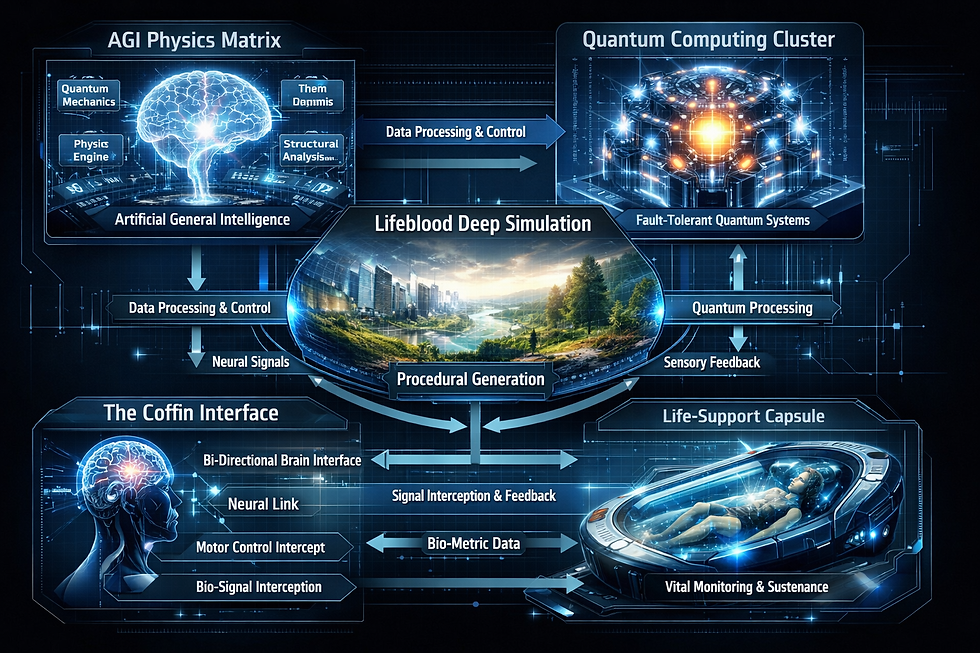
James Dashner’s Lifeblood Deep imagines a virtual reality system so flawlessly immersive that it becomes indistinguishable from lived experience. While Dashner’s depiction is fictional, it provides a conceptual spark for exploring what a real‑world equivalent might require. Drawing on the principles implied in his work (Dashner, 2015), this blueprint outlines the theoretical architecture needed to construct a glitch‑free, physics‑accurate simulation built on AGI, quantum computing, and invasive neural interfaces.
Phase 1: The Core Architect (Artificial General Intelligence)
1.1 Architectural Framework
To create a world that behaves with the consistency of physical reality, the system must be authored not by human programmers but by an Artificial General Intelligence capable of treating physics as a mathematically closed system. Human code is inherently patch‑based and prone to contradiction, whereas a symbolic‑neural AGI can operate on first‑principles reasoning. This AGI would be trained on datasets representing quantum field equations, Navier–Stokes fluid dynamics, general relativity approximations, thermodynamic laws, and finite‑element structural mechanics. These laws form the “physics matrix,” a constraint‑satisfaction environment in which any event that violates conservation laws, boundary conditions, or material limits is treated as a logical impossibility. This mirrors the internal consistency that makes Dashner’s fictional simulation feel so real.
1.2 Real‑Time Optimization Engine
Once deployed, the AGI becomes the simulation’s omnipresent physics arbiter. Instead of relying on pre‑baked animations or simplified rigid‑body approximations, it performs continuous numerical integration of physical interactions. When an object strikes a boundary, the AGI computes kinetic energy transfer, stress‑strain curves, molecular deformation, and potential fracture propagation using real‑time solvers. This ensures that every interaction behaves with the permanence and reliability of nature rather than the fragility of game‑engine shortcuts.
Phase 2: The Core Infrastructure (Fault‑Tolerant Quantum Computing)
2.1 Hardware Layer
A simulation that mirrors reality cannot run on classical binary processors, which evaluate operations sequentially. A fully physical world requires simultaneous computation of millions of interacting variables. A decentralized network of fault‑tolerant quantum computers—each operating with millions of error‑corrected qubits—would allow the system to evaluate collisions, light scattering, atmospheric turbulence, and material interactions in the same millisecond. Quantum superposition enables the system to compute multiple possible physical outcomes simultaneously before collapsing to the correct one, eliminating the lag and clipping that define the limits of modern engines.
2.2 Procedural Rendering Core
Instead of storing a persistent world file, the simulation would generate the environment procedurally around the user using real‑time mathematical reconstruction. Anything outside the user’s sensory bubble exists only as a set of differential equations and coordinate states. When the user’s perception intersects with an object’s location, the system resolves its full physical form instantly by solving the relevant equations. This mirrors the dynamic, perception‑driven environments suggested in Dashner’s narrative, where the world feels both infinite and immediate despite not being fully instantiated at all times.
Phase 3: The Sensory Interface (The Coffin Hardware)
3.1 Neural Synchronization Layer
Dashner’s Coffin serves as the bridge between the human mind and the digital world, and a real‑world equivalent would require a similarly radical interface. A high‑density, bi‑directional neural array—likely based on graphene microelectrodes or optogenetic fiber lattices—would connect directly to the cerebral cortex. This interface would bypass the body’s natural sensory pathways and write data directly into the visual, auditory, somatosensory, and vestibular cortices. By matching the brain’s native firing patterns and temporal coding, the system can generate experiences indistinguishable from reality.
3.2 Motor Command Interception
To maintain immersion while keeping the physical body safe, the system would intercept outgoing motor signals before they reach the muscles. This requires a spinal‑level efferent signal dampening system capable of detecting and blocking action potentials along the corticospinal tract. When the user intends to walk, jump, or reach, the neural command is captured, decoded, and translated into avatar movement while the physical body remains motionless. This ensures perfect alignment between intention and digital action without physical risk.
3.3 The Life‑Support & Isolation Capsule
The user would be suspended in a temperature‑regulated nutrient gel engineered to match the density and thermal conductivity of human tissue. This eliminates the sensation of gravity, pressure, and body weight, creating a full sensory‑deprivation environment that forces the brain to accept the digital world as its primary reality. Continuous biometric monitoring—tracking heart rate variability, blood oxygenation, neural load, metabolic consumption, and muscular atrophy—maintains long‑term safety during extended immersion. This mirrors the total‑reality effect experienced by characters in Lifeblood Deep.
Phase 4: System Integration & Execution
The full system forms a closed loop of perception, computation, and physical law. The user enters the capsule, the neural interface synchronizes with their brain, and the quantum cluster initializes the physics matrix around their starting coordinates. As the simulation runs, the AGI enforces physical law with absolute consistency. No clipping through walls, no falling through floors, no impossible geometry—only a world governed by the same mathematical principles that shape the physical universe. In this sense, the simulation becomes not a game but a parallel reality, echoing the conceptual brilliance of Dashner’s fictional system while grounding its architecture in emerging scientific possibility.
References
Dashner, J. (2015). The Game of Lives. Delacorte Press. (Referenced for conceptual inspiration regarding the Lifeblood Deep system.)


Comments