
The "Wandering Earth" Protocol: A Scientific Blueprint for Indefinite Survival
- jjpresley96

- Apr 16
- 4 min read
The Sun is a ticking clock. In roughly one billion years, increased solar luminosity will boil our oceans; in five billion, the Sun will expand into a Red Giant, vaporizing Earth. Most modern "Plan B" strategies, like terraforming Mars, are short-term bandages—Mars will perish alongside the Sun.
(Solar luminosity increases by roughly 10% every billion years due to core hydrogen depletion and increased fusion rates, driving a runaway greenhouse effect similar to Venus.)
To survive not just for a billion years, but for trillions, we must stop viewing Earth as a static destination and start viewing it as a Planetary Ark.
Phase 1:
The Logistics of Moving a World
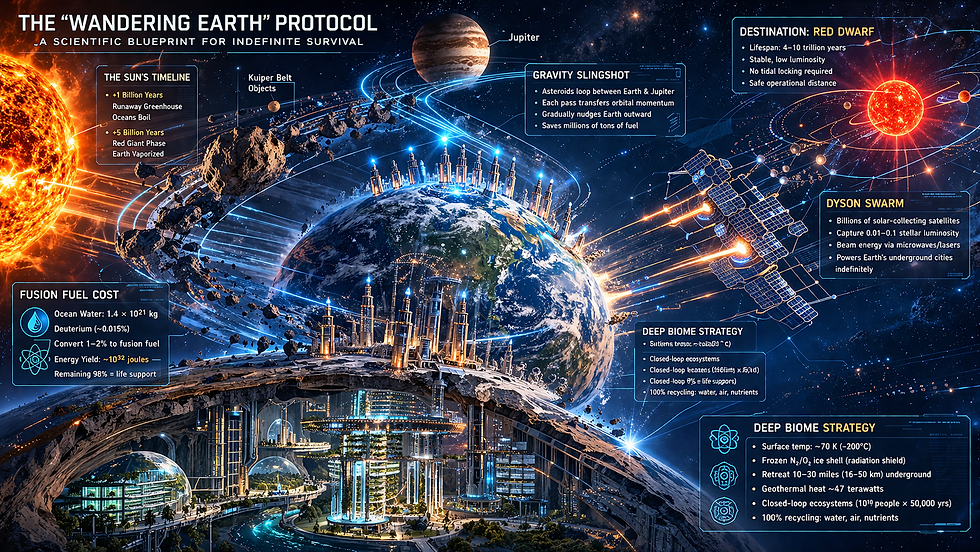
The most plausible way to move 6 sextillion tons of rock (Earth’s mass ≈ 5.97 × 10²⁴ kg) is a combination of "Gravity Tugging" and direct propulsion.(The orbital energy required to shift Earth’s orbit significantly is on the order of 10³³ joules, comparable to the total energy output of the Sun over several days.)
The Gravity Slingshot: We would steer large asteroids or comets (from the Kuiper Belt) to fly in a "loop" between Earth and Jupiter. Each pass transfers a tiny fraction of Jupiter's massive orbital momentum to Earth. (Jupiter’s mass is ~318 times that of Earth, making it an enormous reservoir of angular momentum.) This "free" energy nudges us outward, saving millions of tons of fuel.(This concept is based on gravitational assist mechanics already used in spacecraft navigation, scaled up over millions of iterations.)
The Propulsion Towers: To finish the job, we must build thousands of Fusion Engines—miles-high towers, ideally concentrated at the South Pole to push along Earth’s axis.(These would function as planetary-scale mass drivers or fusion-powered plasma thrusters, ejecting ionized particles at high velocity to generate thrust via conservation of momentum.)
The Fuel Cost: Our oceans contain roughly 1.4 × 10²¹ kg of water. (Hydrogen isotopes within this water, particularly deuterium at ~0.015%, provide a viable fusion fuel source.) To escape the Sun’s gravity and reach 0.01% of the speed of light (~30 km/s, comparable to Earth’s current orbital velocity), we would need to convert approximately 1% to 2% of our total ocean volume into fusion fuel.(Fusion of deuterium can release on the order of 10¹⁴ joules per kilogram, making it one of the most energy-dense reactions available.)The remaining 98% stays as our life-support reservoir.
🛡️ Phase 2:
The "Deep Biome" Strategy
Once Earth leaves the Sun's light, the surface becomes a frozen void at -200°C (~70 K, depending on distance and residual geothermal heat). However, this is a tactical advantage.
The Shield: A frozen atmosphere provides a miles-thick barrier of nitrogen and oxygen ice. (At sufficiently low temperatures, atmospheric gases condense and freeze, forming a dense cryogenic layer.) This "Ice Shell" protects us from cosmic radiation and micro-meteoroids far better than the thin hull of any starship.(High-energy cosmic rays are significantly attenuated by dense layers, and even a few meters of ice can provide substantial radiation shielding.)
Vertical Cities: We retreat to massive, self-sustaining underground biomes carved 10 to 30 miles (16 to 50 km) into the crust. These "Deep Cities" utilize Earth’s internal core heat (geothermal) (global geothermal output ~47 terawatts) supplemented by synthetic "sun" lamps powered by the fusion reactors. (At these depths, temperatures and pressures stabilize, and radiation exposure drops to near-zero levels.)
The Closed Loop: For 10 billion people to survive 50,000 years, every atom must be recycled. Waste is processed into fertilizer; water is purified through the crust; and air is scrubbed by massive subterranean forests. (Closed ecological systems would require near-100% recycling efficiency, as even a 0.01% annual loss compounds to catastrophic depletion over millennia.)
⚓ Phase 3:
The Trillion-Year Arrival Our destination is a Red Dwarf (like Proxima Centauri). These stars are the "slow burners" of the universe. (Red dwarfs have masses between 0.08 and 0.6 solar masses and fuse hydrogen at extremely slow rates.)
The Timeline: While our Sun burns out in a few billion years, a Red Dwarf stays stable for 4 trillion years—nearly 400 times the current age of the universe.(Some estimates extend red dwarf lifespans up to 10 trillion years due to their efficient fuel usage and lack of strong radiation-driven mass loss.)
Dyson Harvesting: We don't need to "park" Earth in a dangerous, tidally-locked close orbit. We can stay at a safe distance and deploy a Dyson Swarm—billions of solar-collecting satellites orbiting the star that beam energy back to Earth via high-frequency lasers (or microwave transmission in the gigahertz range for higher efficiency over distance) to power our underground world indefinitely.(Even capturing a fraction of a red dwarf’s output, typically 0.01 to 0.1 solar luminosity, would provide energy far exceeding current human consumption.)
⚖️ The Paradox of the Architect
This plan is scientifically robust. It utilizes the laws of physics, the abundance of hydrogen, and the insulating power of the Earth’s crust to move humanity from a finite existence to a near-infinite one. We have the minerals, the energy, and the blueprint.
However, the "hole" in this plan isn't in the physics—it's in the passengers.
We currently live in a world of "Grey Buildings" and short-term extraction. Our "smartest" leaders chase Mars for PR victories while a hidden ruling class designs environments to fuel depression and consumption. We act as a species of "clueless toddlers," stripping the play pens and free samples from the world while the house is slowly catching fire.
The theory works. The "Lifeboat" is indestructible. But it leads us to a final, haunting question:
If you were to build the most perfect, trillion-year lifeboat in history, and then you turned to look at the passengers—seeing them fight over the deck chairs while the boat is on fire—would you still believe they deserve the keys to the future? Or would you simply step back and let the ship sink?


Comments